
When does your summer start and end?
Nobody agrees on when summer starts. So I built something to prove it
Ask an astronomer, a meteorologist, and your neighbor firing up the grill when summer starts, and you'll get three different answers — and none of them will be June 1st, June 21st, *or* Memorial Day exactly. I got curious about that gap between the "official" version of summer and the version people actually live by, so I built When Does Your Summer Start and End? a small survey site that asks visitors to define their own summer, then visualizes how that stacks up against everyone else's.The three definitions problem
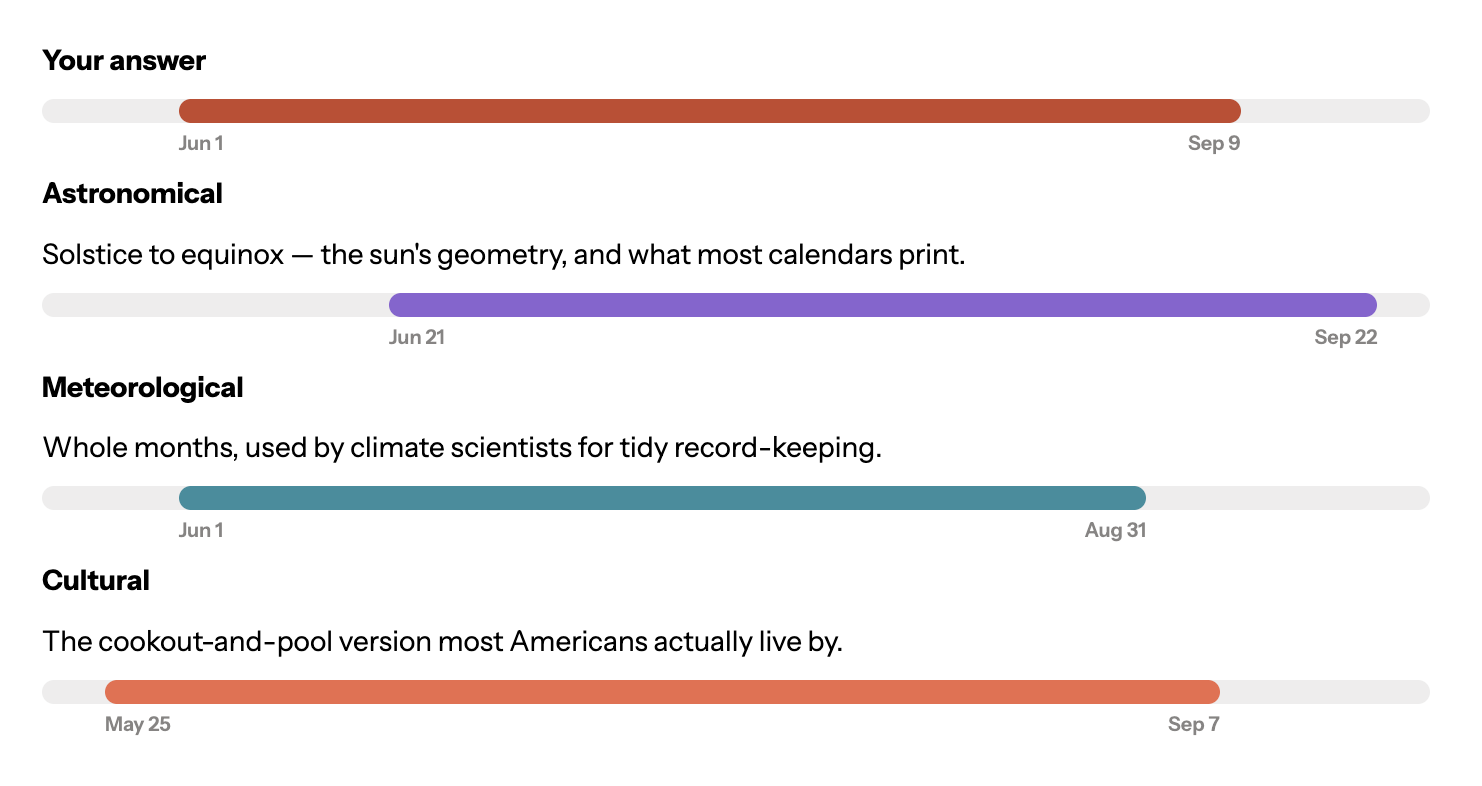
It turns out "summer" already has three official start dates depending on who you ask:
Astronomical — solstice to equinox
Meteorological — a tidy Jun 1–Aug 31, the version climatologists use for record-keeping
Cultural — Memorial Day to Labor Day, the cookout-and-pool version
None of these agree with each other by more than a couple weeks, which is exactly the fun part. The results page lays all three out as a bar chart next to your own answer, so you can see precisely how far off "official" you are.
Crowd Sourcing the Definition of Summer
Get to the data ASAP
The entry point is deliberately narrow: pick your start date, pick your end date, submit. I wanted the friction between landing on the page and contributing a data point to be close to zero to get as many responses as possible. Of course, I also wanted to avoid malicious responses so I built a step that allows me to review responses before adding them to the data set. Those that just want to see the results can skip the form all togther.
Data, three-ways
Once someone submits, they get dropped straight into the results, positioned against the same data they just added to.
1. The many definitions of summer anchors the reader in the three "official" answers before showing them anyone's opinion, so there's a baseline to compare against.
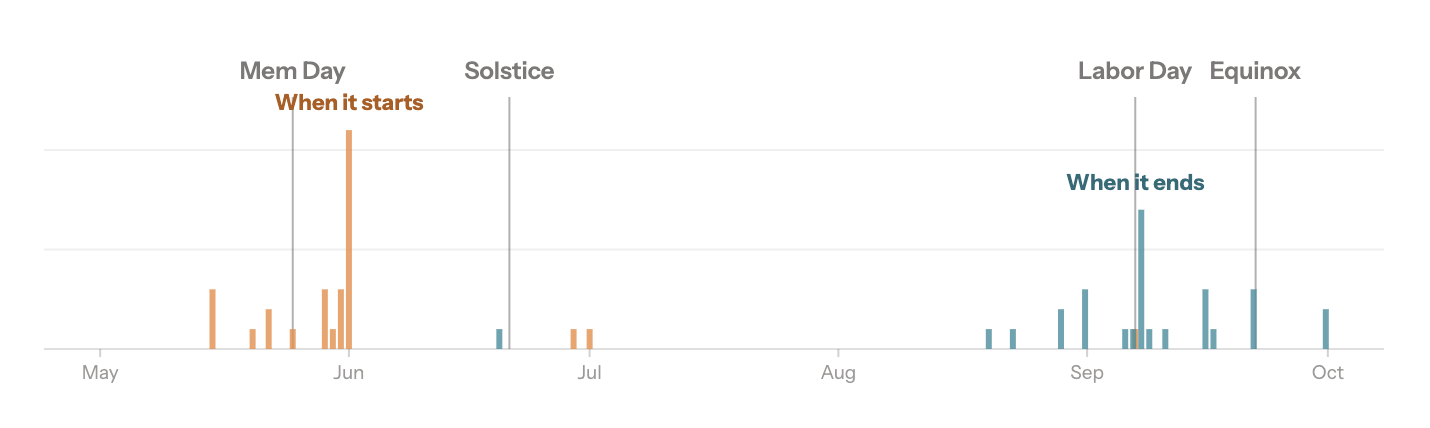
2. When opinions cluster is a histogram of actual start/end submissions overlaid on the official landmarks (Solstice, Memorial Day, Labor Day, Equinox), so you can see how the crowd's answer drifts from and clusters around those markers.
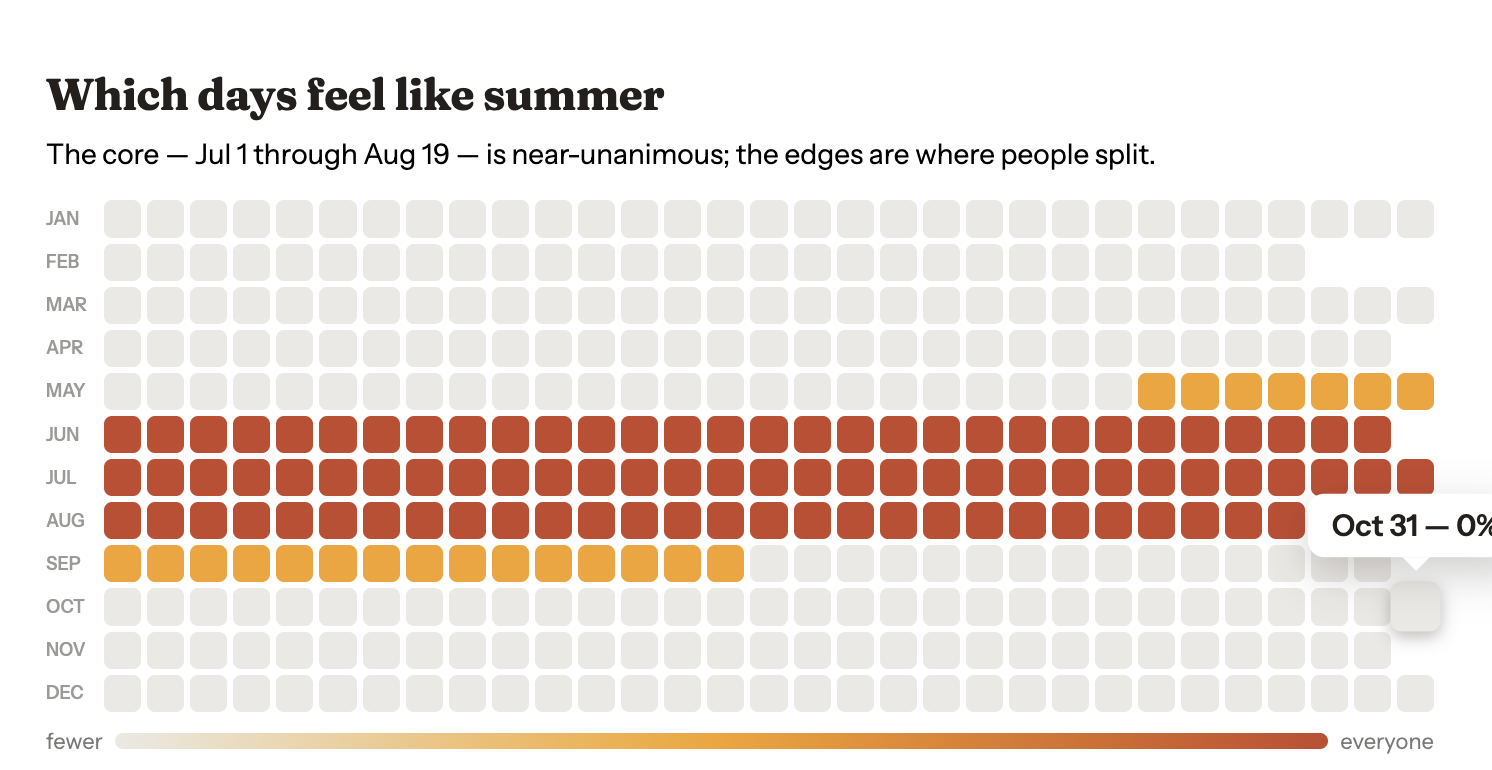
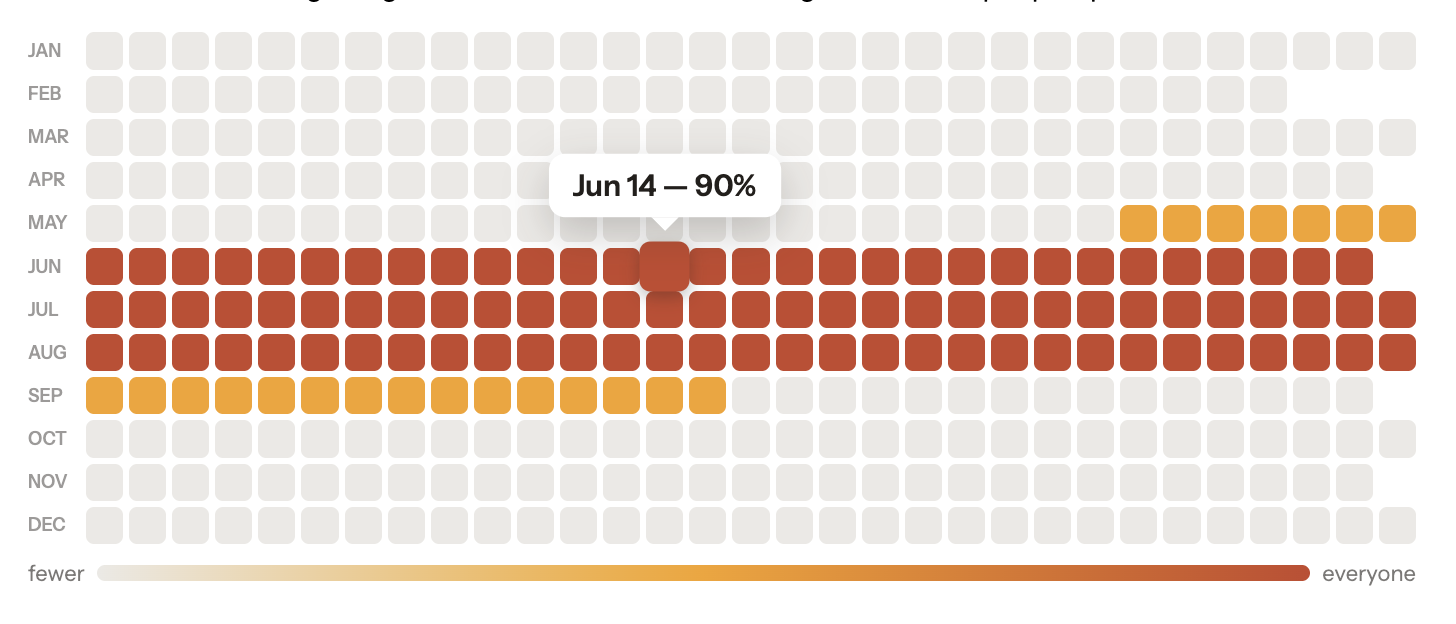
3. Which days feel like summer is a calendar heatmap, day by day, from "fewer people" to "everyone." This one was the payoff I was chasing from the start: instead of one range, you can see the consensus (roughly Jul 1–Aug 19 is near-unanimous) fade out toward the edges where people genuinely disagree.
Stack
Next.js, Postgres, and D3 for the charts, deployed on Heroku. Responses go through a lightweight moderation queue before they count toward the public results, so the data stays clean.

Make it stand out.
It all begins with an idea. Maybe you want to launch a business. Maybe you want to turn a hobby into something more. Or maybe you have a creative project to share with the world. Whatever it is, the way you tell your story online can make all the difference.

Make it stand out
It all begins with an idea. Maybe you want to launch a business. Maybe you want to turn a hobby into something more. Or maybe you have a creative project to share with the world. Whatever it is, the way you tell your story online can make all the difference.

Make it stand out.
It all begins with an idea. Maybe you want to launch a business. Maybe you want to turn a hobby into something more. Or maybe you have a creative project to share with the world. Whatever it is, the way you tell your story online can make all the difference.